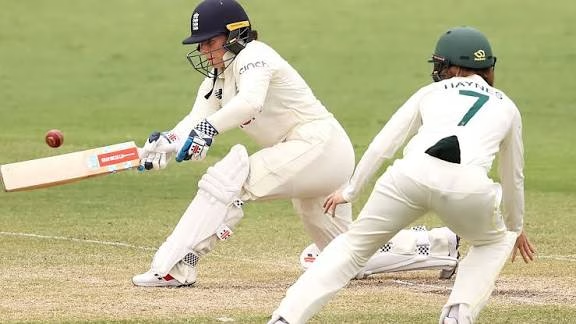
What “Will There Be a Tie” Means in Cricket Betting
This is a Yes/No bet offered by sportsbooks.
You’re betting on whether a cricket match will end in a tie — meaning both teams finish with exactly the same scoreafter the scheduled overs (or innings) are completed.
- YES → You are betting that the match will end in a tie.
- NO → You are betting that the match will not end in a tie (one team will win).
How a Tie Happens in Cricket
A tie in cricket is very rare because:
- It requires both teams to score exactly the same number of runs.
- In limited-overs formats (T20s and ODIs), there’s often a Super Over or tie-breaker, which means the match might not officially end as a “tie” for betting purposes.
Different bookmakers have different rules:
- Some count a match ending in a Super Over as “tied” before the tiebreaker.
- Others settle it based on the Super Over winner.
Always check the bookmaker’s rules.
Example: Team Scenario
Let’s use a T20 International match example.
Example Match: India vs Pakistan (T20)
- India: 182/8 (20 overs)
- Pakistan: 182/7 (20 overs)
The scores are identical → this is a tie.
If you had bet “Yes” on “Will there be a tie?” you’d win.
However:
- If the rules say the Super Over result counts, and Pakistan wins the Super Over,
then the bet on “Yes” might lose (depending on the sportsbook).
So always verify whether “tie before Super Over” or “match result after Super Over” is used.
Real Examples
- IPL 2023 – Gujarat Titans vs Rajasthan Royals
- Match tied at 179–179.
- Super Over played → Gujarat Titans won.
- Bettors who chose “Yes – there will be a tie” won if their bookmaker settled before Super Over.
- 2019 Cricket World Cup Final – England vs New Zealand
- Match tied on 241 each.
- Super Over also tied.
- England won on boundary count.
- Bettors with “Yes” for tie won depending on the sportsbook’s rule at the time.
Betting Tips
- Focus on T20 and ODI Matches
- Ties are more likely in shorter formats like T20s than in Test matches.
- Look for Evenly Matched Teams
- Teams like India vs Pakistan, South Africa vs New Zealand, or England vs Australia often play tight finishes.
- Balanced bowling and batting strength make ties slightly more possible.
- Check Pitch and Conditions
- On low-scoring pitches (120–150 runs), a tie becomes more likely because totals are tighter.
- On high-scoring pitches (180+), one big over can break the balance.
- Compare Odds
- “Yes” for a tie usually has very high odds (often between 20.00 and 50.00).
- This means even a small stake can return large profits if it happens.
- Follow Live Bets
- Some sportsbooks offer in-play tie markets (e.g., “Will the scores be level after 40 overs?”).
- You can bet live if the game is getting close.
- Avoid Test Matches
- Test matches rarely end in ties — only two in cricket history (India vs Australia 1986, England vs Australia 1960).
Example Betting Slip
| Match | Market | Bet | Odds | Result | Outcome |
|---|---|---|---|---|---|
| India vs Pakistan (T20) | Will there be a tie? | Yes | 26.0 | Match tied | Win |
| England vs Bangladesh (ODI) | Will there be a tie? | No | 1.02 | England won | Win (small profit) |
Summary
| Aspect | Explanation |
|---|---|
| Bet Type | Yes/No bet on whether the match will end in a tie |
| Best Formats | T20, ODI |
| Key Factors | Balanced teams, low-scoring pitch, close chase |
| Odds Range | 15.00 – 60.00 (very high reward) |
| Risk Level | High |
| Best Strategy | Small stake, big reward on evenly matched T20 games |
Would you like me to give you a list of teams and leagues where ties occur most often, such as in IPL, Big Bash, or International T20s?
Leave a Reply